Cindy Wongpanich
World Literature Honors 5
Ms. Bennett
13 March 2015
Voices of Change
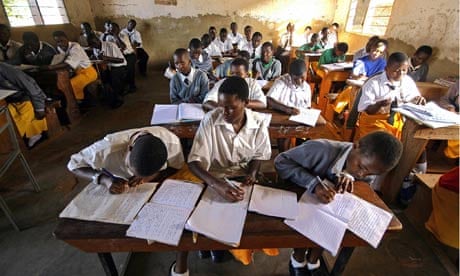
Just outside the doors of South African schools still tainted with apartheid-era influence, students congregate to defend their right to education. They break out into songs of freedom as their poignant cries for substantial education echo within their vacant, littered schools. Today, the remnants of apartheid suppression still plague South Africa’s children, hindering their potential for prosperous futures. Though its deficient education system cannot be pinpointed to one root cause, schools have suffered the greatest detriments from the growing prevalence of teacher absenteeism and racial discrimination.
At the Kwamfundo High School in Khayelitsha, South Africa, students have turned their frustration with inattentive teachers into violence. In one instance, students “threw bricks, punched two teachers, and stabbed one in the head with scissors.” (Dugger). Their violence is fueled by the rampant “teacher-absenteeism” that has grown overbearingly present in schools across South Africa. Teachers consistently arrive to school late, teach less than half their required time, and oftentimes fail to show up altogether. Despite many teachers’ incompetence and failure to pass already lenient teaching standards, 15,000 unqualified teachers are hired each year, only further perpetuating the mediocre education (Over the Rainbow). As teachers’ punctuality, engagement, and qualification have diminished, matric passing rates of South African students have plummeted from to 75% to 44% (Dugger). While the aspirations of students wishing to break apartheid legacy has risen, South African schools have fallen back into the turmoil of apartheid-era schooling with their inadequate teaching. The education system has yet to part ways with not only its failed infrastructure, but also its discriminatory implementations.
“If you say 3 times 3, they will say 6,” says at math teacher at Kwamfundo High School, depicting the widening education gap between whites and natives. Such inequality traces back to the “Bantu” education system, implemented in apartheid-era South Africa as a method to train natives to become “subservient laborers’ (Dugger). This mindset still holds true today, when in sixth grade, two out of one thousand sixth graders in native schools pass the same mathematics exam that two out of three white children do. By ninth grade, the gap widens as literacy rates in native schools wane to a mere 14%. Once in the twelfth grade, native students’ pass rates diminish to only half that of white students (Govender). The inequality sustains itself years later, when the unemployment rates for blacks is more than five times greater than that of whites. So long as discrimination between race prevails, South Africa will continue to retain its fractured education system.
Apartheid’s legacy remains nestled in South African schools, embodied by the weary minds of the oppressed and in the frustrated cries of ambitious students with stolen potential. Outside the doors of their schools, the students of South Africa cry out for their freedom through the booming voices of millions yearning for education. They will not be silenced, for only with the fervor in their voices will change ever come.
Works Cited
Brown, Gordon. "Bridging Education Gaps Key to Developmental Path." Gale Student Resources in Context. Africa News Service, 3 Dec. 2013. Web.
Dugger, Celia W. "Eager Students Fall Prey to Apartheid’s Legacy." The New York Times. The New York Times, 19 Sept. 2009. Web. 09 Mar. 2015.
"Education and Adolescent Development." UNICEF South Africa. UNICEF, n.d. Web. 09 Mar. 2015.
Govender, Thashlin. "The Education Gap- Practical Solutions to Key Barriers." University World News. University World News, 20 Apr. 2013. Web. 09 Mar. 2015.
"Over the Rainbow." The Economist. The Economist Newspaper, 20 Oct. 2012. Web. 09 Mar. 2015.
Rusznyak, Lee. "South African Education Still Fails Many 20 Years after Apartheid." The Conversation. The Conversation, 7 May 2014. Web. 09 Mar. 2015.

I really like the quotes that you used to prove your point. This contrasts with the US because there is not as big a learning gap. Is the government turning a blind eye to these issues or are they trying to help?
ReplyDeleteI like how you use statistics to support your arguments.
ReplyDeleteI find the violence against teachers interesting, as a lot of people have talked about lack of access to education as a cause of violence, but you talk about how even a poor education will still bring violence.
When did the trend of incompetent teachers start?
Learning about teacher absenteeism was very interesting, as I didn't know it was a problem. This reminds me a lot of the education problems America faces in middle and lower class/minority filled schools. What tactics will the government use to help change this problem? Will they actually help?
ReplyDeleteIt is so surprising how many inattentive teachers are employed in South African schools. This is so contrasting to America because there are such strict guidelines for a teacher to be hired here and such strict rules to maintain equality. How much will the children have to suffer before actual equality is achieved and they can receive the education they deserve?
ReplyDeleteI figured the people of South Africa who were qualified as teachers would want to close the gap between the whites and blacks, but clearly not all of them. The statistics are evident to this. This was very interesting when compared to how American students react when they feel a teacher is not doing well. Who is hiring these teachers and how are they graduating and getting jobs?
ReplyDeleteI did not know that the education system was this bad in South Africa. This contrasts with the US, and makes you realize just how lucky we are. Why doesn't the government, or citizens, work to repair this issue?
ReplyDeleteVery well written article, Wongpanich! This article made me realize how much potential lies in the African education system; yet, the system fails due to the tardiness of the teachers! It is funny to compare this to US school systems, where we hardly stress over arriving late to school. Meanwhile, when teachers arrive late to school in Africa, it means the schoolchildren have a smaller chance to succeed. I wonder how racial discrimination is still so prevalent in the schooling of white versus black students, despite the ending of apartheid?
ReplyDelete